


Reaction Response to Vlad Savehuk – Is Christmas Pagan?

Is Christmas Pagan?
A Biblical and Historical Examination
Introduction: The Question That Divides Christians
A Reaction Response to Pastor Vlad Savchuk by Jim Staley
 Is Christmas pagan? Should Christians celebrate it? These questions are at the center of a growing debate within the Christian community. In this virtual discussion, Pastor Vlad Savchuk and Pastor Jim Staley engage one another on the origins, theology, and biblical legitimacy of Christmas.
This conversation is not about motives, sincerity, or salvation. It is about authority, worship, and whether God has given permission to sanctify December 25 as a holy day in His name.
Before engaging the debate, it’s important to understand the framework from which this discussion proceeds.
The First-Century Foundation of Faith
This channel is dedicated to uncovering the first-century Hebraic roots of the Christian faith—the Jewish worldview, Hebrew language, idioms, and cultural context from which Christianity was born. Rather than filtering Scripture through later Protestantism, Roman Catholicism, or church tradition, the goal is to return to the original intent of the biblical authors themselves.
If we fail to do that, we inevitably read into Scripture what we already believe. One of the topics that demands this level of scrutiny is Christmas. Why are Christians celebrating holidays that originated outside of biblical instruction? And why are Protestants often defending traditions that were formally established by the Roman Catholic Church?
With that framework established, let’s begin the debate.
Claim #1: “The Origin of a Symbol Does Not Determine Its Meaning”
Pastor Vlad’s first claim is that even if certain Christmas symbols originated in pagan cultures, their modern Christian use redeems their meaning. He argues that pagans also used everyday items like candles, greenery, buildings, bread, wine, and even named the days of the week after pagan gods. If Christians rejected everything pagans once touched, we would have to abandon daily life altogether.
A Critical Distinction: Objects vs. Worship Structure
This argument contains a crucial oversight. Scripture does not forbid the use of generic objects simply because pagans once used them. God never condemned houses, clothing, calendars, or language. In fact, Israel itself used the days of the week and lived within pagan cultures.
The issue arises when objects used in pagan worship are inserted into the structure of worship to the one true God. Deuteronomy 12 makes this distinction unmistakably clear.
“You shall not worship the LORD your God in that way… Whatever I command you, be careful to observe it; you shall not add to it nor take away from it.” (Deut. 12:31–32)
God forbids borrowing the worship methods of pagan nations—even if the intention is to honor Him. The problem is not where something was made, but how it was used.
Deuteronomy 12: God’s Litmus Test for Worship
When Israel entered the Promised Land, God warned them explicitly not to imitate the worship practices of the nations they displaced. Even if the object or practice was redirected toward Yahweh, it would still be unacceptable. God’s concern was not creativity—it was obedience.
This principle is repeated throughout Scripture:
- The golden calf (Exodus 32)
- Jeroboam’s unauthorized feast days (1 Kings 12)
- Unauthorized altars and locations of worship
In each case, worship was directed toward the true God—but through unauthorized means. God rejected it every time.
Claim #2: “December 25 Was a Christian Date Before Paganism”
Pastor Vlad argues that Christians were associating Jesus’ birth with December 25 before pagans celebrated that date. Historically, this claim does not hold up.
The Historical Record Tells a Different Story
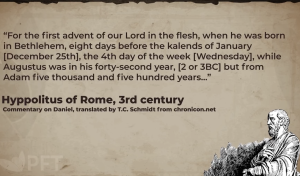 There is zero evidence of Christians celebrating December 25 before it appears on the Roman Philocalian Calendar in 354 AD. Some cite Hippolytus of Rome (early 200s), but the alleged December 25 reference is a later medieval interpolation, admitted even by critical scholars and the Catholic Encyclopedia itself.
In the earliest manuscripts, Hippolytus gives no date for Jesus’ birth.
Pagan Solar Worship Predates Christianity
Long before Christianity:
- Egyptian sun-god theology associated divine birth with the winter solstice (Plutarch, Isis and Osiris)
- Sol Invictus, the Roman sun god, had his birthday on December 25
- Saturnalia and other Mediterranean pagan festivals surrounded the same date
The Roman calendar of 354 AD lists both:
- Natalis Invicti (Birth of the Unconquered Sun)
- The birth of Christ
This demonstrates not coincidence, but overlay.
Claim #3: “Jesus Was Conceived on March 25, So He Was Born on December 25”
This argument is often attributed to early church fathers like Tertullian and Augustine.
The Historical Problem
- Clement of Alexandria (early 200s), the first Christian writer to discuss possible birth dates of Jesus, lists numerous dates—but never December 25
- Tertullian never claimed Jesus was conceived on March 25
- The idea appears only in later centuries, retroactively applied
This is not primary evidence—it is theological reconstruction after December 25 was already established.
Claim #4: “God Can Redeem Pagan Holidays”
This is one of the most serious theological claims in the debate.
Scripture Says Otherwise
Nowhere in Scripture does God:
- Redeem pagan holy days
- Rename pagan festivals for His worship
- Approve borrowed worship structures
Instead:
- Pagan altars are destroyed
- Pagan days are rejected
- Pagan worship methods are condemned—even when done “unto the Lord”
God redeems people, not pagan rituals.
“You were redeemed from your futile ways inherited from your forefathers.” (1 Peter 1:18)
God replaces rival worship—He does not recycle it.
Claim #5: “You’re Celebrating an Event, Not a Date”
Dates matter to God.
If they didn’t:
- Passover could be moved
- Yom Kippur could be rescheduled
- God’s feast calendar would be irrelevant
But Scripture is explicit: God sanctifies time.
Holy days are not casual commemorations. They are acts of worship structured in time—and only God defines them.
Romans 14: A Misused Passage
Romans 14 is about fasting, not establishing holy days.
Paul is addressing situations where God did not give instructions—therefore allowing liberty. Holy days are the opposite. God gives explicit instruction about worship and forbids innovation.
To apply Romans 14 universally would justify:
- Any ritual
- Any day
- Any method
As long as someone claims it’s “unto the Lord”
Scripture does not allow that.
Christmas, Sacredness, and the World
Christmas is often called “sacred,” but biblically speaking, only God makes something sacred (kadosh).
When man sets something apart, it is tradition—not holiness.
Marriage, love, and sexuality were created by God and can be redeemed. Christmas was not given by God and therefore cannot be reclaimed as sacred time.
Christmas Trees, Santa Claus, and Pagan Parallels
Across ancient cultures:
- Sacred evergreen trees were symbols of life
- Odin, Yule, and Norse mythology directly influence modern Christmas imagery
- Santa Claus parallels Odin’s mythology strikingly
While some origins are debated, the sheer volume of parallels raises serious concern. Scripture consistently urges caution—not comfort—when pagan worship overlaps with devotion to God.
Final Conclusion: Who Defines Sacred Time?
This debate is not about love for Jesus.
It is not about sincerity.
It is not about judging others.
The real question is this:
Who has the authority to define sacred time—God or man?
Scripture answers clearly:
- God sanctifies time
- God defines worship
- God alone authorizes how He is approached
December 25 was a pagan holy day long before it was Christianized. Church leaders later admitted they adopted it to redirect existing customs—not because God revealed it. God condemns that practice.
This does not mean Christians who celebrate Christmas are evil or unsaved. It is not a salvation issue. But it does mean the practice itself cannot be justified biblically, historically, academically, or archaeologically.
In the garden, there were two trees:
- The Tree of Life
- The Tree of the Knowledge of Good and Evil
One was pure. The other was a mixture.
With all its blended origins, unauthorized worship, and borrowed sacred time, the question becomes unavoidable:
Which tree does Christmas belong to?
Two trees.
One choice.
And that choice still matters.
Watch full video here: https://youtu.be/D4R59EvaAoY

Download Full transcript


Jim Staley
Jim’s life’s desire is to help believers everywhere draw closer to the Father by understanding the truth of the scriptures from their original cultural context (a Hebraic perspective) and to apply them in faith for today.


