


Decoding Hebrews Summary

A Fresh Look at Hebrews:
Covenant, Priesthood, and Faithfulness
What if everything you were taught about the book of Hebrews missed its original meaning? What if the phrase “the old covenant is growing old and ready to vanish away” was never meant to imply that God’s law was abolished—but instead reflected a first-century Jewish idiom that the original audience immediately understood?
Recovering that single historical insight changes how the entire book of Hebrews is read.
This article offers a high-level overview of Hebrews from its original Hebraic and Jewish context—the perspective of the first-century believers to whom it was written. Rather than reading Hebrews through a modern Western lens, we step back into the world of the Temple, the Torah, and the dramatic transition from the Levitical priesthood to the eternal priesthood of Messiah Yeshua (Jesus).
What Hebrews Is Really About
 Hebrews has often been portrayed as the book that separates the “old covenant” from the “new,” suggesting that God’s law was discarded and replaced. That assumption, however common, does not reflect the author’s intent.
Hebrews is not about abolishing the Torah. It is about a change in priesthood and covenant administration.
The audience consisted primarily of Jewish believers—many likely living in Rome—whose entire religious life revolved around the Temple in Jerusalem. For centuries, the Levitical priesthood had administered worship, sacrifices, and atonement. Suddenly, these believers were confronted with a radical claim: Messiah Yeshua had risen from the dead and now served as High Priest—not on earth, but in heaven, in the order of Melchizedek.
This was unprecedented. Hebrews was written to answer one central question:
How does faith in Yeshua transform Temple worship, priesthood, and covenant life—without discarding God’s law?
Hebrews 1–2: Messiah Is More Than a Messenger
The book opens by establishing Yeshua’s identity. He is not merely a prophet, angel, or exalted human being. He is the eternal Word—the exact representation of God’s nature—through whom the universe was created and sustained.
Hebrews echoes passages such as Isaiah 45, Philippians 2, Micah 5, and John 1 to affirm that the Messiah shares in God’s glory and authority. The author’s point is foundational: this High Priest is divine, eternal, and preexistent.
Chapter 2 then warns believers not to drift away from this revelation. Salvation does not originate in Temple rituals but in the Messiah who stands at the center of God’s redemptive plan—uniting Jews and Gentiles into the commonwealth of Israel.
Hebrews 3–4: Moses, Messiah, and the Sabbath Rest
Hebrews 3 does not pit Moses against Messiah. Instead, it compares their roles within the same household of God. Moses was a faithful servant; Yeshua is the faithful Son and heir. The house remains the same—the leadership over it changes.
Chapter 4 builds on this theme by emphasizing Sabbath rest. Far from being abolished, the Sabbath becomes a living symbol of trust, faith, and future hope. The author intentionally uses the Greek word sabbatismos to affirm that “a Sabbath rest still remains for the people of God.”
The weekly Sabbath serves as a reminder of the ultimate rest found in Messiah and the coming age.
Hebrews 5–7: The Priesthood of Melchizedek
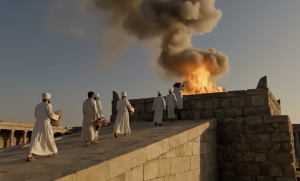 At the heart of Hebrews lies the revelation of the Melchizedek priesthood.
Unlike the Levitical priesthood—which depended on lineage, succession, and repeated sacrifices—Melchizedek’s priesthood is eternal, heavenly, and superior. Hebrews shows that even Abraham acknowledged Melchizedek’s authority by offering him a tithe, meaning Levi himself (still in Abraham’s lineage) recognized a higher priesthood.
The author carefully explains that the Torah itself anticipated this change (Psalm 110:4). The law did not fail; human priests did. Therefore, the law governing who may serve as priest changed—not the moral and covenantal foundation of God’s instructions.
Hebrews 8–9: Covenant vs. Law—A Critical Distinction
One of the most misunderstood ideas in Hebrews is the relationship between covenant and law.
A covenant is a relationship framework.
The law defines the terms within that relationship.
Hebrews 8 explains that the “fault” of the first covenant was not the Torah—but the people who failed to keep it. Jeremiah’s promise of a new covenant did not abolish God’s law; it relocated it—from stone tablets to human hearts.
When Hebrews says the old covenant was “growing old and ready to vanish,” it refers to the Levitical administration, which was about to disappear with the destruction of the Temple in 70 AD. The law remained. The priesthood changed.
Hebrews 9 explains that Messiah’s death satisfied the covenantal requirements once and for all, allowing a new administration—under a perfect, eternal High Priest—to begin.
Hebrews 10–11: Faith as Covenant Loyalty
Hebrews 10 emphasizes that repeated sacrifices could never cleanse the conscience. Messiah’s sacrifice, offered once, accomplished what the Levitical system could not.
This leads directly into Hebrews 11, often called the “Hall of Faith.” But biblical faith is not mere belief—it is emunah: steadfastness, faithfulness, and covenant loyalty expressed through obedience.
Faith is evidence. It is endurance under pressure. It is trust lived out in action. Every example in Hebrews 11 demonstrates faithfulness, not intellectual assent.
Hebrews 12–13: Running the Race and Living It Out
Hebrews 12 calls believers to run the race unencumbered—laying aside spiritual “weights” that hinder intimacy with God. These weights include bitterness, fear, shame, pride, and unforgiveness—forms of spiritual uncleanness that must be removed to live freely.
The book closes in Hebrews 13 with practical exhortations: love others, show hospitality, praise God continually, and live without fear. Sacrifice is no longer centered on animals but on praise, generosity, and obedience flowing from the heart.
The Big Picture of Hebrews
Hebrews teaches us that:
- The priesthood has changed—from Levi to Melchizedek
- The covenant administration has shifted, not the law
- Access to God has moved from an earthly temple to a heavenly one
- Sacrifices have been elevated from shadow to substance
- Faith is lived covenant loyalty, not abstract belief
- Messiah Yeshua is the eternal High Priest and mediator
The law remains. Grace reigns through a better priesthood.
Hebrews is not a rejection of God’s instructions—it is a call to live them out through Messiah, empowered by grace, rooted in faithfulness, and anchored in a heavenly reality.
If you desire a deeper, verse-by-verse exploration of Hebrews through its original Hebraic context, the full teaching series offers rich insight into first-century culture, language, and theology.
Hebrews reminds us of this timeless truth:
The shadow has passed. The substance has come. And there is no way forward—except through Yeshua.

Watch the full teaching here:
https://youtu.be/TUD6yKKrISQ


Jim Staley
Jim’s life’s desire is to help believers everywhere draw closer to the Father by understanding the truth of the scriptures from their original cultural context (a Hebraic perspective) and to apply them in faith for today.


